
Turning Military Service Into A Powerful Resume
- Nick Zwei

- Jun 16, 2021
- 7 min read
Updated: Feb 8, 2025
Your military service is coming to an end and so begins the post service career search in the civilian sector. For you, like many others who joined the service right out of high school, it may be the first time that you ever had to search for a real (civilian) career. Through the military, you have gained valuable knowledge and skills that are sought in many well-paying career areas. But today, there is more to applying for a job than just filling out a single-page application, much like you did for that entry level job flipping burgers for minimum wage in your teenage years. Now, one of the key tools you need to get your foot in the door for just an interview is a glowing resume.
No matter the Branch a service member was in, the military has given them the tools to record and define their time in the service. All a military member needs to do is collect this information and organize it according to the desired sections on the resume.
For the intents of this article, I will reference the Army as I will pull from my own personal experiences and background to provide detailed examples for you to follow. Each service provides similar documentation of service, often these will be under different titles or document numbers.
Much of what a military member needs to build a resume can be found in: the ''me book'' (a personal folder or binder that holds all awards, certificates, and important documents a person has received), counseling packet, ERB/ORB (Enlisted or Officer Record Brief - Army), and JST (Joint Service Transcript). These items are invaluable in providing information to put together a great resume.
Though resume structure and design may vary with societal whims and/or purpose (i.e. university, specialized careers, etc.), the contents are generally the same. For this article, we will focus on the four most common areas used on resumes. These areas are: experience, education, professional development, and skills.
EXPERIENCE
Just as it implies, this area is where one lists their professional experience. There are a couple of ways one can break this down, either by positions held or time at location. Either way, always go chronologically, with the most current position on top and going down to the most distant.
To list experience by positions held, one lists their time of employment by the position they held and mark a new date with each promotion or change in job title.

This type of format works well if you have stayed at one organization for an extended period of time and have held various job titles or had multiple changes in responsibility.
The other method is to list experience by location.

This works nicely for those who had multiple changes in duty stations and between these moves had relatively minor changes in responsibilities at their assigned organizations. For the job title one lists the last position(s) held within that organization. Feel free to still mention a promotion or change in responsibility in one's work history details, as these look favorable to prospective employers.
Once you chose your preferred format for listing your experience, start filling in the details of your experience. Here you describe both, your job and your accomplishments.
In one or two bullet points describe what your actual task or job was, for example:
''Provided police and emergency support to a community of 40,000.''
''Supervised the daily activities of a 12 person squad.''
Most employers are more interested in what one has accomplished than an explanation of the job. So don't focus too much on describing your task(s), instead focus on one's accomplishments or detailed responsibilities. These should be measurable and/or provable.
Counseling packets and awards are two prime areas to gather the details to explain your experiences.
Monthly and annual counseling offer a good insight and record of your activities while with a unit. Scour these to find items that make you stand out or define your job and accomplishments.
Awards can also help define your experience. When an award is submitted for approval, there is almost always a reason for your leadership to request that award. That request should list the accomplishment that made you stand out among your peers. Provided below is an example on how information was pulled from an award and put into a resume.


Note how five of the eight bullet points can be traced back to the award document shown above. Also each bullet point is concise and has a measurable detail, so a prospective employer can visualize the tasks and responsibilities.
In some instances, one may have the opportunity to request additional information from the organization one was assigned to; for example, in bullet point 2 of the example above, I gained that information by requesting data from the administrators of the police department I had been assigned. The police administrators graciously provided the information I was seeking - ''ask and you shall receive...''
Many employers look at levels of responsibility by value in one's control (asset or monetary). In bullet point 7, I provide an estimated value of all the military items I had signed custody over, such as: basic military gear, vehicle(s), equipment, weapons, etc. This should be a ''give-me'' for all military members. According to The Wall Street Journal, in 2007 the average soldier had signed for about $17,500 worth of gear. That is not counting if they are assigned a vehicle, an arms room, tech equipment, supply room, heavy weapons, team gear, etc. All employers like value-based responsibilities, as they easily define the trust and responsibility previous employers held you to.
Employers also like to know that you went above and beyond what you are required to do. That you are a person of action. In bullet point 8, I provided the total number of awards I had received. These include anything from certificates of achievements to recognition for service or valor. Most civilian employers wouldn't understand military awards if you list them individually - ''what is a good conduct medal?'' However, notating awards for service, provides proof that you went above and beyond what was required of you and your leadership recognized your value. These can be listed and expanded upon during the interview process. Do understand though, if you received a particularly high honor, you may list that individually as this is an exception to general military awards for service, i.e. an award that is in recognition for valor.
EDUCATION
When it comes to education, one may list some military schools, as one would any college or university education. The type of military schools included in this section should be primarily ones at military branch levels that granted the student an occupation specialty, skill identifier, or leadership training (i.e. WLC, ALC, OCS, etc). These military schools offer valuable lessons and skills that may be transferable to a civilian career. Follow the same rules as one would in listing civilian education. List education by level of importance or by highest degree value on top and the lesser valued education towards to bottom.

With some schools, listing courses or skills gained with that education may help an employer better understand the valuable knowledge gained through that school. An example is provided for infantry school below.

If you do use this method, try to focus on only listing courses or skills relevant to the position you are applying for.
If a student receives an honor or recognition for excellence through the school or academy, it is good to notate that under the appropriate education. This is similar to earning the Dean's List, valedictorian, or other academic honors and listing them on a resume.
PROFESSIONAL DEVELOPMENT
In the professional development section of the resume a warrior lists all the lesser courses and training gained. These are often unit level, online, basic certifications, etc., such as combat life saver, combatives, advanced driver's course, air assault, airborne, etc.
When listing these, stick strictly with training that is relevant to the job you are seeking. Employers may only glance over the piles of applications they receive and if your's is fill with irrelevant information it may be trashed.
Look over both your training certificates and your Joint Service Transcript to find training that may be relevant. This includes courses and college level testing a service member may have taken through their local education center.
Below are two sections from a Joint Service Transcript (JST). These, in addition to information from certificates I hold, will be used to help demonstrate how one can pull information and place it in an application for a job in security or law enforcement.
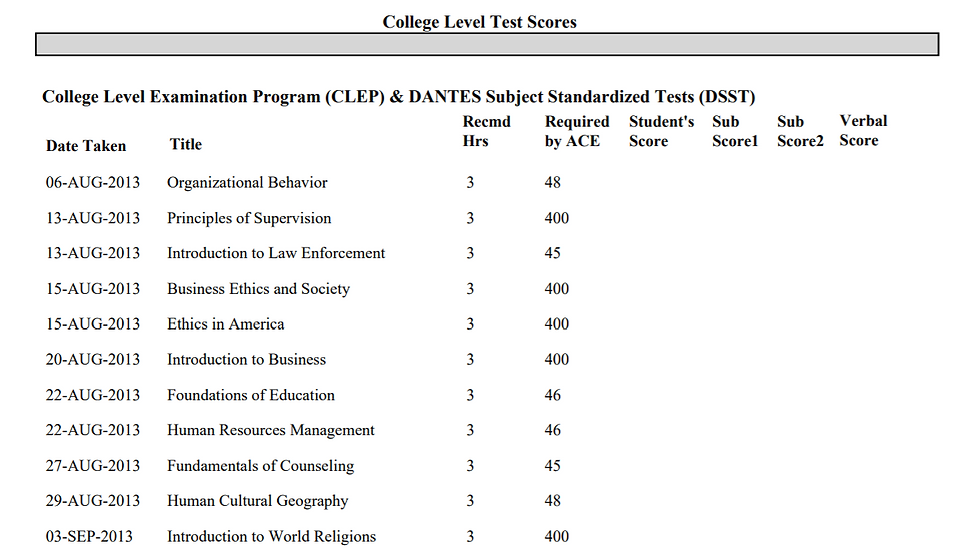

Now applying these to a resume's Professional Development section for the security/law enforcement job may look like:

Notice that I didn't include certain information that may not be relevant to the job. I also avoided using annual online courses that the Army or unit had me do. In many cases, these are not pertinent outside of military. This is more of a personal preference and in some cases may be acceptable to add to a resume.
Additionally, I made sure to list the college level exams as such and not as a course or actual training. One may ask why I would even list these. The reason is, these are evaluations intended to gauge a person's knowledge on particular topics and are recognized and recommended by ACE (American Council on Education) as eligible for college credit. Even if an applicant has not had these exams turned into credit by attending an institution of higher learning, an employer may find this knowledge useful in determining a candidate's eligibility for a job.
SKILLS
In this area, one lists skills that are relevant to the job and may not be highlighted in other areas of the resume. Avoid using broad or redundant terms such as adaptability, teamwork, decision making, etc. Focus instead on listing particular technical or target skills that you hold and the employer is seeking. Don't be afraid to describe the skill using more than one or two words. For example, instead of just saying ''adaptability,'' say, ''Experienced in adapting to rapidly changing environments and situations'' or instead of just "computer programs'' state "software such as, SPSS, SAS, etc.''
The key is to use terms or short descriptions that highlight skills that are required for the job. If the terms are too vague or broad, the employer may just pass it over. A true professional will be articulate and concise in their description of skills they are proficient or experts on.
CONCLUSION
As a military member, no matter one's occupation specialty or rank, we received training and experience that is invaluable in obtaining a career in the civilian sector. However, it is important to keep one's career expectations realistic. And when it comes to your resume, do a hard sell of your experiences, accomplishments, knowledge, and skills. When describing them, be concise and detailed, while not overstating or falsifying your history. Look over all your documents, certificates, awards, and transcripts, and ask yourself - how would this be relevant to the job, and how do I articulate it clearly to a prospective employer? What does this say about me: my experiences, my accomplishments, my knowledge, or my skills?


Comments